Lupton Veterinary Services Ltd.

Equine Dentistry
Our passion is equine dentistry!
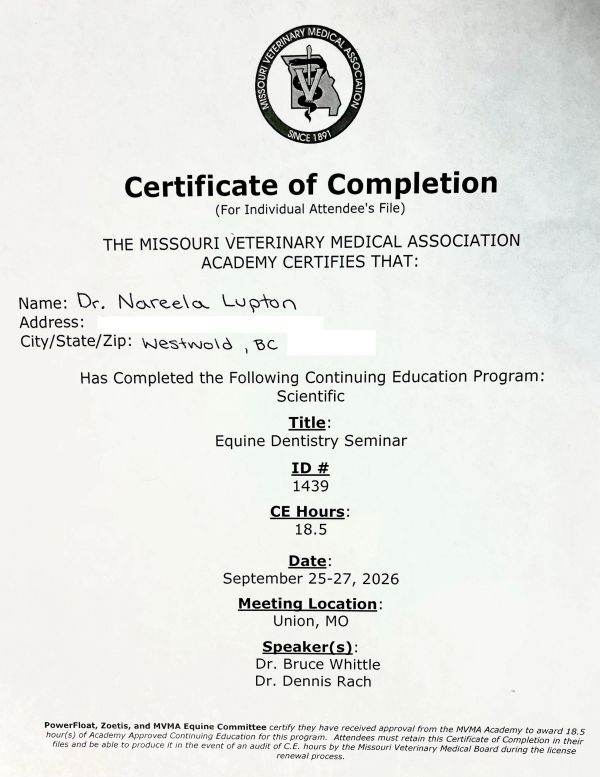
We are dedicated to regularly attending continuing education in order to offer the most up to date advanced oral exams and treatments. Dr. Lupton has over 7 years experience working as an equine veterinarian in a busy GP practice. She is comfortable with horses of all shapes, sizes, and temperaments. Dr. Lupton is heading to Missouri in Sept 2026 for the Missouri Veterinary Medical Association Fall Wet Lab for even more advanced training in equine dentistry!
We have invested in the most cutting edge dental equipment including a Geysir X water irrigation system, HDE Dental Scope, Pegasos high precision extraction equipment, and a Swiss Vet float. We have both hanging dental halter and an adjustable head stand depending on your horses needs and barn set up.
Our Services
- Routine dentals
- Diagnosis and treatment of common dental pathologies including malocclusions, periodontal disease, EORTH, infundibular caries
- Dental extractions, diastoma widening
- Annual Vaccinations
CFIA Accredited Veterinarian
- Coggins Testing for EIA (Equine Infectious Anemia)
- Equine Health Certificates for Export to USA
- Pet Bird Health Certificates for export to USA
Appointments
To book an appointment, please send us an email luptonvet@gmail.com
Current Hours:
Saturdays 11AM- 4PM
Tuesdays/Thursdays 10AM -3PM
We do not provide after hour emergency care.
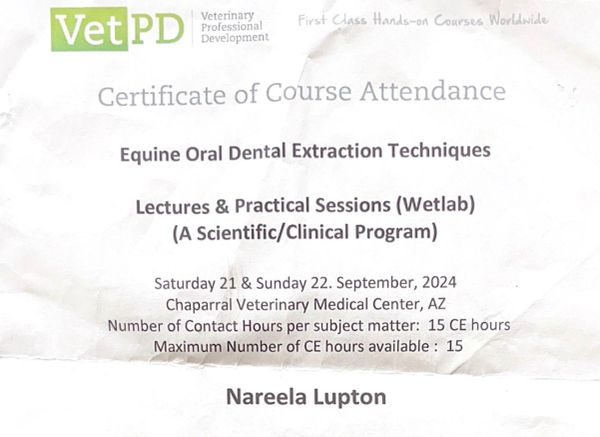
Certificates


EQUINE DENTISTRY

Tooth Mobility Scoring
- 0 No Mobility
- 1 First discernible sign of mobility
- 2 <3mm tooth movement
- 3 >3mm tooth movement, tooth can be compressed into alveolus (Requires extraction)
Infundibular Caries
- Stage 1 - infundibular cement
- Stage 2 - infundibular cement & infundibular enamel
- Stage 3 - infundibular cement, infundibular enamel & dentin
- Stage 4 - CCRF (sagittal fracture through infundibula)
Sharp Enamel Points
All it takes is one to cause discomfort!
Here is a great photo of a very common lingual hook formation phenomenon in a young horse on the 408 premolar (aged 3-5yrs).
A hook on the 408/308 tooth in an adolescent horse typically happens due to:
 𝙀𝙧𝙪𝙥𝙩𝙞𝙤𝙣 𝙖𝙨𝙮𝙢𝙢𝙚𝙩𝙧𝙮: The 308/408 tooth (4th premolar on lower arcades) erupts at approximately 4 years of age. Since it is the last premolar to erupt, it can be delayed, or crowded relative to its upper counterpart (the 108),or maligned and the surfaces won't grind together perfectly resulting in a hook.
𝘼𝙣𝙤𝙩𝙤𝙢𝙞𝙘𝙖𝙡 𝘼𝙣𝙞𝙨𝙤𝙜𝙣𝙖𝙩𝙝𝙞𝙨𝙢: Horses naturally have a wider upper jaw than lower jaw, If a young horse has a slight structural misalignment—such as the upper jaw sitting slightly forward—the inner or edge surfaces of the upper teeth fail to make contact with the lower arcade during normal circular chewing, leading to rapid hook formation.
EORTH
Equine Odontoclastic Tooth Resorption and Hypercementosis
Most often affects permanent incisor (front teeth) and canine teeth, but also occasionally the premolars.
Most commonly affects horses >15 years of age.
Rostral Hook
Excessive Transverse Ridges & Sharp Enamel Points
Can lead to infundibular caries and periodontal disease on the apposing tooth if not treated.